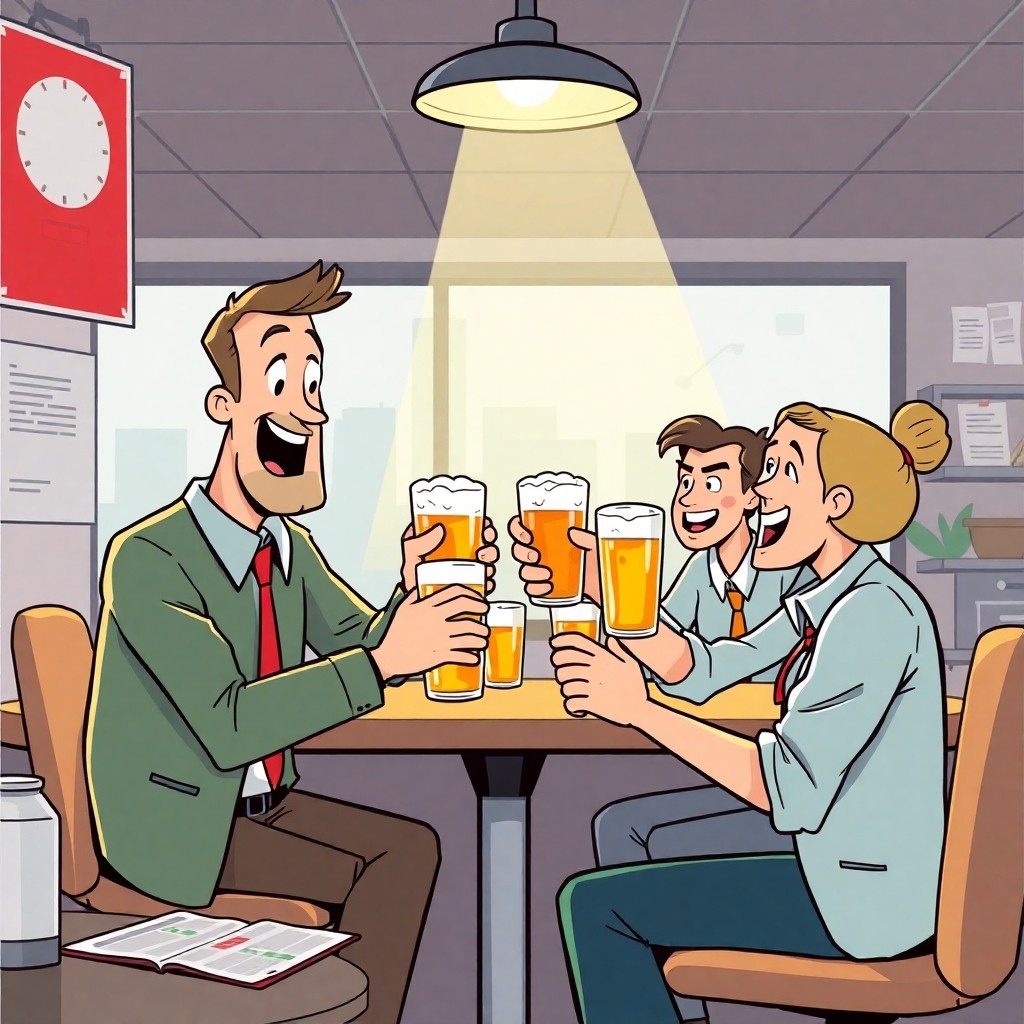
At a corporate event you can drink as much as you want. Or you can't. Much of that is decided by your manager - not on the night itself, but months earlier, in how the company culture got built. Swedish researchers went and asked managers directly: what can you actually do about how your team drinks?
What they did
In-depth interviews with 44 middle and senior managers. Participants were asked to think out loud: what levers do you see at your own level for cutting alcohol consumption? The answers went through thematic analysis - a method that looks for recurring meanings and patterns instead of counting percentages.
For interpretation they leaned on Ames' 1992 cultural model, which splits the alcohol environment into four parts: norms, climate, availability, formal control. Alcohol as a system, not as a private choice made fresh every time.
Genevieve Ames showed this back in the early 1990s: how much and how a person drinks depends less on willpower than on surroundings. Her cultural model stands on four things - norms (what counts as "normal" drinking in your circle), climate (whether the mood nudges you toward a glass or away from it), availability (how easy it is to reach the bottle and pour), and formal control (whether rules exist and whether anyone actually follows them). The practical upshot: fighting alcohol in a vacuum is a losing game. Changing the surroundings works better - the people around you, the rituals you're used to, how close the bottle sits. Those four levers are where a conscious approach starts.
What they found
Managers named four levers they hold.
Event format. The activity itself decides a lot. A table with food and drinks is one thing. A quest, a concert, a hike is a different evening entirely. Then the details on top: limited pours, non-alcoholic options set out next to the alcoholic ones.
Personal example and conversation. A manager who takes water or lemonade sends a signal without saying a word. And an open conversation about drinking, without judgment, cuts pressure better than an unspoken norm does. Dialogue works where orders don't - that came up again and again.
HR support. Clear rules on where and how much is appropriate, training, HR actually involved. That's the formal frame. Without it everything else sags: even a well-meaning manager hits a wall sooner or later if the organization gives them nothing to lean on.
The general well-being context. The least obvious lever of the four. Managers who watch psychological safety, workload balance and team climate move drinking habits too - simply because there's less stress to unload. Alcohol at work is often tension relief. Less tension, less demand for it.
The bottom line
Alcohol at work reads like a personal choice. The surroundings say otherwise: who reaches for a glass first, whether there's anything on the table besides wine, how the boss reacts. Background pressure, quiet enough that you never register it.
If you're an employee, that's a reason to read the corporate party as a system. "In this setting a different choice costs more" is a more useful sentence than "I have no willpower."
If you're a manager, you have more levers than it looks. Not bans and lectures. What's on the table, how you behave yourself, what your team is allowed to talk about.
Limitations
Qualitative research. 44 people is stories, not statistics. Nobody here can say "method X cuts consumption by Y%." What you get instead is how managers actually reason about the topic.
Participants were managers only. What employees make of their bosses in this context, nobody asked. And people already interested in prevention agree to such interviews more readily, so the sample tilts. The study ran in Europe; how far the findings travel to other corporate cultures is untested.
Source: International Journal of Qualitative Studies on Health and Well-being, DOI